What happens to the soul at the moment of death — not to the body, which medicine can describe, but to the part that feels, remembers, and loves? Michael Newton, a hypnotherapist who spent decades guiding clients into the space between lifetimes, compiled thousands of accounts of exactly that transition. His subjects described it with a consistency that is hard to dismiss: a gentle pulling away, a sense of lightness, and then — something that felt more like arrival than departure.
Michael Newton, a hypnotherapist who spent decades regressing clients into the space between their lifetimes, compiled thousands of accounts of that precise moment. His 1994 book Journey of Souls remains one of the most detailed portraits we have of what his subjects consistently described as the soul’s departure from the physical body — and the first moments of what comes after.
The Release
According to Newton’s research, the departure of the soul from the body is not violent or frightening. Subjects described it as a gentle pulling away — a sense of lightness, of release, as though something that had been compressed for a very long time was finally allowed to expand.
Many of Newton’s clients reported watching their own body from above almost immediately after death. This is consistent with a vast body of near-death experience (NDE) literature, but Newton’s subjects went further: they described a quality of awareness that felt sharper, clearer, and more spacious than anything they had experienced in their physical lives. One subject described it as «taking off a very heavy coat you’d forgotten you were wearing.»
The timing of departure, Newton’s subjects noted, is not always instantaneous. In cases of sudden death — accidents, heart attacks — the soul often lingers near the body for a brief period, adjusting to the new state of being. In cases of prolonged illness or old age, the soul may begin the departure process earlier, sometimes traveling partially out of the body in the days or hours before physical death.
The Tunnel
Perhaps the most widely reported element of the near-death experience — the tunnel of light — appears in Newton’s accounts as well, though his subjects described it with more specificity than most NDE reports.
Newton’s subjects described moving through what felt like a dark passage or corridor, drawn forward by a gentle but unmistakable pull. The darkness was not frightening — several subjects used words like «velvet» or «soft» to describe it. It was, they said, simply the transitional space between one state of existence and another, not unlike the few seconds between deep sleep and waking.
At the end of the passage, light. Not a blinding or overwhelming light, but warm — the kind of light that feels like a destination rather than a source. Newton’s subjects consistently described a sense of recognition at this point, as though they were returning somewhere familiar after a very long time away. «Like coming home,» one subject said, «but a home I’ve never been to in this life.»
The tunnel, in Newton’s framework, is less a literal structure and more a perceptual experience — the soul’s way of processing the shift from dense physical matter to the lighter, freer energy of the spirit world.
The First Moments
What strikes most readers of Newton’s work is the emotional quality of those first moments after death. There is no terror, no darkness, no punishment — at least not in the immediate aftermath. What Newton’s subjects described, again and again, was an overwhelming sense of peace.
Some described feeling emotions they hadn’t been able to feel clearly in their physical lives: a kind of clarity about relationships, regrets, and joys that had felt murky while they were alive. One subject described suddenly understanding, with crystalline precision, why certain things in her life had unfolded the way they did — not with judgment, but with simple, calm comprehension.
Others described a sensation of being met — not immediately by guides or loved ones (that comes later, according to Newton’s accounts), but by something more diffuse: a welcoming quality to the light itself, as though the environment of the spirit world recognizes each returning soul.
Newton noted that the experience of those first moments varied somewhat depending on the soul’s level of experience and the circumstances of the death. Souls who died unexpectedly sometimes required more time to orient themselves. Younger souls — those with fewer lifetimes behind them — sometimes needed more support in those initial moments. But across all accounts, one element remained constant: the absence of the fear that had accompanied so many of the souls’ physical lives.
What This Means for Us
Whether or not you take Newton’s regression accounts as literal truth, there is something worth sitting with in the consistency of what his subjects described. Across thousands of sessions, across different ages, backgrounds, and belief systems, people reported the same essential experience: that death is not an ending but a transition, and that the transition is gentler than we have been taught to fear.
For those of us carrying grief — for someone we’ve lost, or for the life we know we’ll eventually leave — this is not a small thing. The image of a soul gently releasing from a body, moving through soft darkness toward warm light, arriving somewhere that feels like recognition and peace: this is a very different story than the one our fear tells us.
Newton was careful throughout his work to note that he was reporting what his clients described under hypnosis, not making metaphysical claims about absolute truth. His subjects were the authority on their own experience. But the remarkable coherence of those experiences across so many different people, over so many years, invites at least a pause — a willingness to consider that the moment of death might be one of the most profound and peaceful experiences available to a human soul.
The heavy coat comes off. The light is warm. Something in us already knows the way.
Related Articles
- What Happens to the Soul at the Moment of Death: Michael Newton’s Cases
- What Happens Immediately After Death: The First 49 Days
- The Tunnel of Light in Near-Death and After-Death Experiences
- Beginner Souls & First Incarnation: Newton\’s Findings
- Spirit Guides Between Lives: Michael Newton’s Research
Disclosure: As an Amazon Associate, Reincarnatiopedia earns from qualifying purchases. This helps support our research and publishing at no extra cost to you.
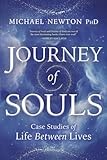
Journey of Souls: Case Studies of Life Between Lives
Michael Newton, Ph.D.
★★★★★ (4,800+ reviews) · $13.99
Newton’s landmark work — 29 case studies of people under hypnosis recounting their experiences between lives. The book that launched the field of Life Between Lives research.

Destiny of Souls: New Case Studies of Life Between Lives
Michael Newton, Ph.D.
★★★★★ (4,200+ reviews) · $11.50
The sequel to Journey of Souls — 67 new cases exploring soul groups, life planning, the Council of Elders, and soul advancement levels in the spirit world.

Life Between Lives: Hypnotherapy for Spiritual Regression
Michael Newton, Ph.D.
★★★★★ (900+ reviews) · $13.36
The professional guide to Newton’s LBL hypnotherapy method — used by certified practitioners worldwide to help clients explore their soul’s journey between incarnations.